
Proposing changes
Use the ProposedChanges plugin of the Editing Toolkit to let users review changes from an AI agent, a script, or a service before anything reaches the document. The plugin provides the Proposed changes UI: a panel that lists the changes, with an optional preview in a balloon next to the affected content. Users can apply a change directly, record it as a Track Changes suggestion, or reject it. They can also apply or suggest all remaining changes at once.
The changes come from Comparing documents, which compares the new content with the current document.
A script updates the event details in the demo below. Choose Propose changes to compare the result with the document and review the differences in the panel. Apply or reject each change, or preview it in the document. Reset the demo to start again.
Team offsite: spring planning
Our spring planning offsite takes place on March 12 at the Riverside Conference Center. Please confirm your attendance by the end of February.
Agenda
- 09:00 – Welcome and coffee
- 10:00 – Review of the last quarter
- 13:00 – Planning workshops
Travel
The company covers train tickets. Book them through the travel portal and keep the receipts.
Parking at the venue is limited, so we recommend public transport.
Contact
If you have any questions, write to the events team.
The script produced this version of the document. Choose Propose changes to compare it with the editor content.
Choose Propose changes above, then review the changes here.
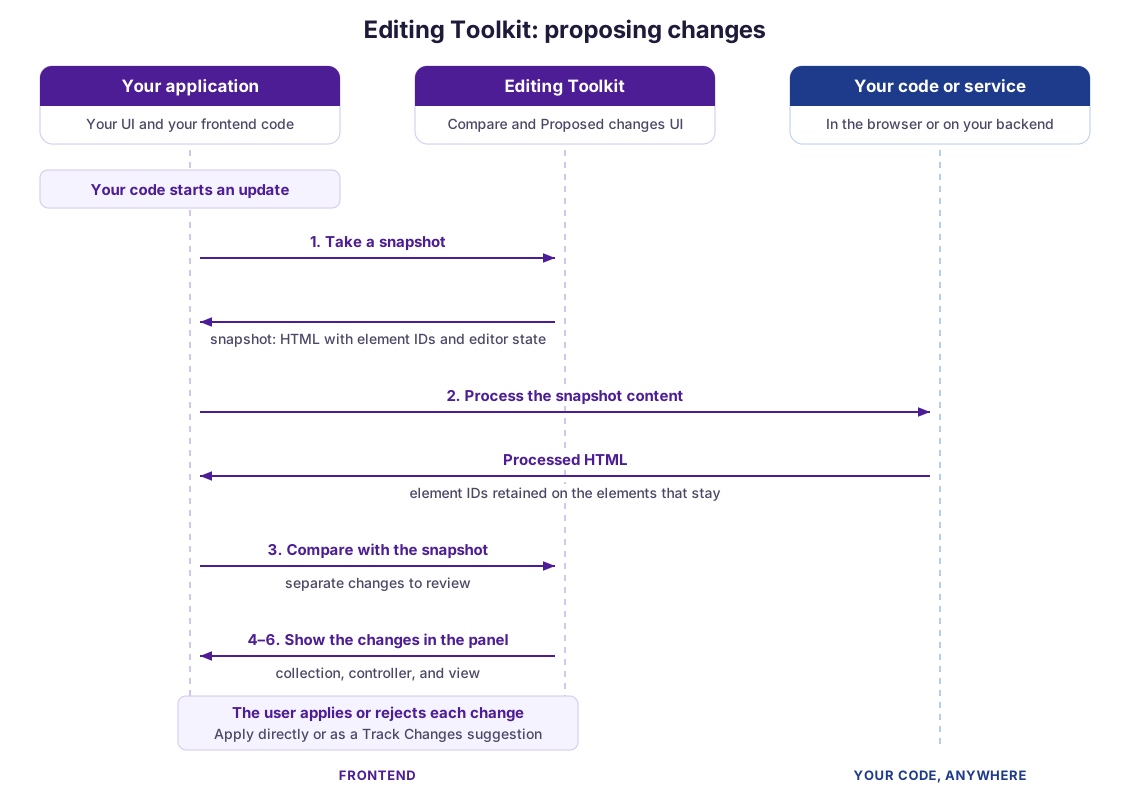
The UI is a standalone component that you place anywhere in your layout, for example in a sidebar, a dialog, or your own chat. It does not take HTML or patches directly. It takes the changes computed by DocumentCompare.
Proposing changes takes six steps:
- Snapshot –
makeSnapshot()captures the current document. See What a snapshot holds. - Process – Your code or service transforms the snapshot content. See the Comparing documents guide for details.
- Compare –
computeChanges()compares the processed content with the snapshot and returns one change per reviewable part of the document. UnlikecomputePatch(), which returns one patch for the whole document, it splits the differences so users can decide on each one separately. - Collect – A
ProposedChangesCollectionholds the changes and tracks whether each one is pending, accepted, or rejected. - Control –
createController()binds the collection to the editor and provides methods to apply, reject, and preview the changes. - Present –
createView()creates the UI. Attach it to the controller and add its element to the page.
After installing the editor, add the DocumentCompare and ProposedChanges plugins to your plugin list. ProposedChangesCollection is a class you create in your code, not a plugin.
import { ClassicEditor } from 'ckeditor5';
import { DocumentCompare, ProposedChanges } from 'ckeditor5-premium-features';

ClassicEditor
	.create( {
		attachTo: document.querySelector( '#editor' ),
		licenseKey: '<YOUR_LICENSE_KEY>',
		plugins: [ DocumentCompare, ProposedChanges, /* ... */ ],
		collaboration: {
			channelId: 'document-id'
		}
	} )
	.then( /* ... */ )
.catch( /* ... */ );For previews in the balloon, also add the AIChatBalloon plugin. To apply changes directly, you do not need Track Changes or an AI service. To let users record changes as suggestions, also set up Track Changes, including registering the current user. See the Track Changes integration guide for details.
The editor must have config.collaboration.channelId set, even when you use a single editor without real-time collaboration. The controller uses it to match each change with its editor. Setting it does not enable Cloud Services or real-time collaboration. If it is missing, the editor throws an error.
The following example runs the six steps one by one. Replace externalDataProcessing() with your own processing:
import { ProposedChangesCollection } from 'ckeditor5-premium-features';

const documentCompare = editor.plugins.get( 'DocumentCompare' );
const proposedChanges = editor.plugins.get( 'ProposedChanges' );

// 1. Capture the document.
const snapshot = documentCompare.makeSnapshot();

// 2. Process the content.
const processed = await externalDataProcessing( snapshot.content );

// 3. Compute the changes.
const changes = documentCompare.computeChanges( snapshot, processed );

// 4. Collect them.
const collection = new ProposedChangesCollection( changes );

// 5. Bind them to the editor.
const controller = proposedChanges.createController( collection );

// 6. Show the review.
const view = proposedChanges.createView();

controller.attachView( view );
document.querySelector( '#review' ).appendChild( view.element );When the review ends, destroy the controller and the view:
controller.destroy();
view.destroy();To compare content that cannot keep the data-id attributes, such as Markdown or a converted Word file, take the snapshot with useDataIds: false. See Comparing content without data-id attributes.
One reviewable change can contain several edits. The computeChanges() method groups related edits that are next to each other. All edits inside a table (except layout tables) or inside an element without paragraphs, such as an image with a caption, always form one change.
To change these rules, for example for your custom elements, use the isAtomic option of computeChanges(). It is called for every element that exists in both versions. Return true to keep all changes inside the element together, false to allow separate changes, or undefined to use the default rules:
const changes = documentCompare.computeChanges( snapshot, processed, {
	isAtomic: element => element.is( 'element', 'myCustomWidget' ) ? true : undefined
} );If the processed content comes from AI, pass the aiSource option to computeChanges(). Changes that users apply or suggest are then marked as made by AI in Track Changes and revision history. The option works the same as in Comparing documents, which also describes the related configuration.
const changes = documentCompare.computeChanges( snapshot, processed, {
	aiSource: 'myAgent'
} );The view returned by createView() is a panel that lists the changes. Each change has its own actions, and the panel also has actions for all changes at once. Place view.element wherever it fits your application.
Which actions the panel shows depends on Track Changes in the reviewed editors:
- The action to record changes as suggestions appears only if every reviewed editor loads the
TrackChangesplugin. - The action to apply changes directly disappears if a user turns on Track Changes in any reviewed editor.
The panel shows each change as a diff by default. Call controller.setShowDiff( false ) to show only the proposed content.
By default, users review the changes only in the panel. To also show a preview of each change in a balloon next to the affected content, pass the hasPreview option to createController(). The preview requires the AIChatBalloon plugin:
const controller = proposedChanges.createController( collection, {
	hasPreview: true,
	autoAdvanceDelay: 600
} );The balloon opens when a user clicks a change in the panel. The editor scrolls to the affected content, and the balloon shows the change with buttons to apply, suggest, or reject it, and to move to the other changes.
After a user applies, suggests, or rejects a change, the preview moves to the next change. The autoAdvanceDelay option sets how long it waits first, so users can see the result. The default is 600 milliseconds. Set it to 0 to move on immediately. Calls to the controller methods never wait.
Besides the UI, the controller lets you review changes from your own code. Changes are addressed by their index in the collection:
applyChange()– Applies a change directly withapplyChange( index, false ), or as a suggestion withapplyChange( index, true ).applyAllChanges()– Applies all changes that can still be applied, with one undo step per document.rejectChange()– Rejects a change and leaves the document as it is. There is no method to reject all changes at once.scrollToChange(),highlightChange(), andpreviewChange()– Help users find a change in the document.
Each change has a state: pending, accepted (applied directly or as a suggestion), or rejected. Undo in the editor sets an applied change back to pending.
A pending change cannot be applied when its content was removed or its editor was destroyed (outdatedState), when it has nothing to apply (emptyReason), or when its content is read-only (isReadOnly).
Changes can only be applied in the editing session in which their snapshot was taken. After a page reload, compute them again.
To rebuild a review from saved decisions, save the state of each change when it is updated. The collection fires the changeUpdated event for every update:
collection.on( 'changeUpdated', ( evt, { index, change } ) => {
	savedStates[ index ] = change.state;
} );Then pass the states back with the changes when you create the collection:
const collection = new ProposedChangesCollection(
	changes.map( ( change, index ) => ( { ...change, state: savedStates[ index ] } ) )
);Changes without a state start as pending. The editing session rule still applies: pending changes can only be applied in the session in which their snapshot was taken.
A single review can cover several editors. Load ProposedChanges in a Context shared by the editors, and DocumentCompare in each editor. Give each editor a distinct config.collaboration.channelId, so every change is matched with its document. See the Using context with collaboration features guide for more about the context.
import { Context, ClassicEditor } from 'ckeditor5';
import { DocumentCompare, ProposedChanges } from 'ckeditor5-premium-features';

Context
	.create( {
		licenseKey: '<YOUR_LICENSE_KEY>',
		plugins: [ ProposedChanges ]
	} )
	.then( context => Promise.all( [
		ClassicEditor.create( {
			context,
			attachTo: document.querySelector( '#editor-a' ),
			plugins: [ DocumentCompare, /* ... */ ],
			collaboration: { channelId: 'document-a' }
		} ),

		ClassicEditor.create( {
			context,
			attachTo: document.querySelector( '#editor-b' ),
			plugins: [ DocumentCompare, /* ... */ ],
			collaboration: { channelId: 'document-b' }
		} )
	] ) )
	.then( /* ... */ )
.catch( /* ... */ );Compute the changes in each editor, then review them together with a controller created by the context:
const collection = new ProposedChangesCollection( [ ...changesA, ...changesB ] );
const controller = context.plugins.get( 'ProposedChanges' ).createController( collection );The channelId identifies the editor, while a change’s rootName identifies the root within that editor. For multi-root editors, see the AI in multi-root and multi-editor setups guide.
If an editor is destroyed during the review, its changes become outdated with the editor-removed state.
- Comparing documents – Compute the changes that this UI presents.
- Editing Toolkit overview – Learn about all components of the toolkit.
- Track Changes – Required only for recording changes as suggestions.
The Proposed changes UI uses the following API:
ProposedChanges– The plugin. UsecreateController()to create a controller andcreateView()to create the UI.ProposedChangesController– Applies, rejects, and previews changes, and connects the UI to the editors.ProposedChangesControllerOptions– ThehasPreviewandautoAdvanceDelayoptions of the controller.ProposedChangesCollection– The set of changes under review and their state.DocumentChange– A change computed byDocumentCompare.ProposedChange– A change in the collection, with its review state.ProposedChangeState– The possible review states.